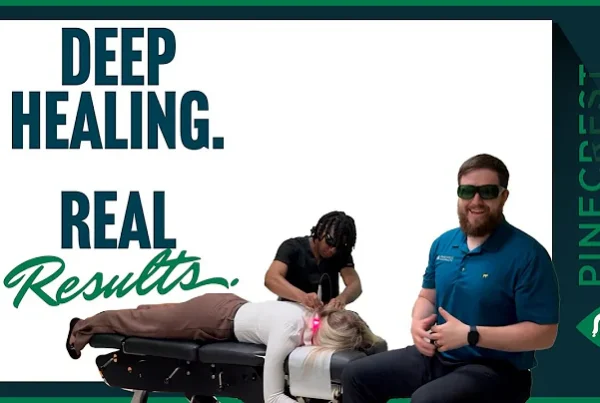
Hey guys, this is Dr. Watt from Pinecrest Chiropractic. Let’s talk about our three favorite adjustments to do when you’re struggling with sciatica. And so we have three different ways to do it.
1. Flexion Distraction Table
Our primary one to use is this flexion distraction table. This works really, really well on opening up that space for patients who are having sciatica from a disc or lumbar spine injury.
As we talked about before, sciatica is when pain’s coming from the sciatic nerve, either starting in the low back into the hip or all the way down the leg. And so this first treatment is gonna work really, really well, especially for that lumbar spine area, whether it’s a disc or whether it’s something else in that area, subluxation, something putting pressure on that.
So the first thing we’ll do is we’ll stretch this patient out. This is the distraction part, and then we’ll move them into flexion. And so this table’s gonna swing up and down.
I’ve got a handle up here on her lumbar spine so we can work through each specific segment. Moving her feet up and down, we’re gonna pump those joints here.
So that’s gonna, one, get those joints to move a little bit better, take pressure off the sciatic nerve at the nerve root itself, and even start to help with that disc healing.
This is one of the other treatments we do for disc injuries, which can often cause sciatica.
2. Drop Table Adjustment
And so if this is not the right fit for that patient or this isn’t the way we wanna treat them, the next step that we’ll do is a drop table.
Now, we’ve used these drop tables on other types of adjustments before, and this works really well on both the lumbar spine and/or if your issue is coming from an SI joint. So we’ll differentiate those two things during an exam.
The table pops up like that, and then as we press down on the low back, the table’s gonna make a big pop and bump like that.
And so what we’ll do is we’ll be right on that contact, putting force through that joint, whether it’s the SI joint there or whether it’s the lumbar spine. Or if we need to attack both individually, we will.
But this type of adjustment is gonna better restore that motion through the joint, helping the healing process that’s happening in that area to take pressure off that sciatic nerve and decrease the symptoms that are radiating down the leg.
So that’s our second favorite type of adjustment for that.
3. Side Posture Adjustment
The third type of adjustment we’ll do is what’s called side posture.
So I’ll have you lay on your side facing me, and this is kinda like a big chiropractic pretzel. This is gonna allow us to get some more of a rotational force through the lumbar spine.
This can also adjust the SI joint as well. So this type of adjustment works great for either SI or lumbar, depending on how much torsion we have on this and what point we are dropping on the patient.
So we’ll turn towards me. Good.
So that motion there is gonna go through that SI joint and/or through that low back and get those joints to move again. Once again, getting pressure off that sciatic nerve and keeping that irritating pain that’s going down the leg, down the leg.
How Sciatica Symptoms Can Change During Treatment
As we treat, we’ll oftentimes see that pain start to centralize, meaning it’s not going as far down the leg.
So sometimes that means it’s gonna have less low back pain—I’m sorry, less leg pain—and pull it more into the low back so we can continue to treat.
But those are three of the best ways to adjust for that.
If you wanna figure out which one’s gonna work best for your condition, come on in. Let’s chat about it.