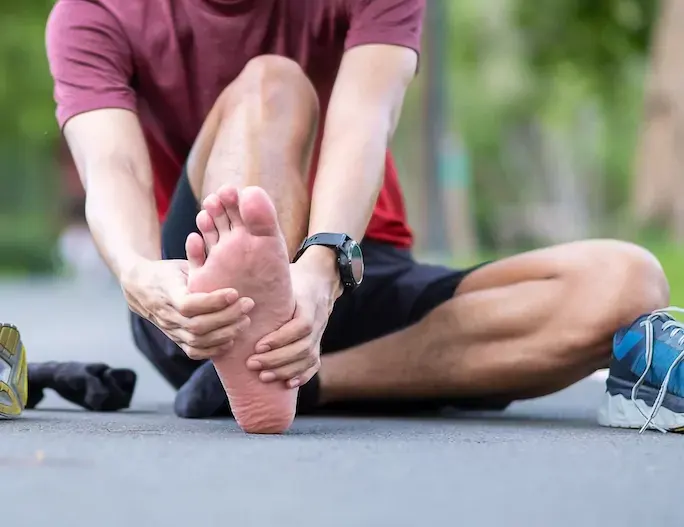
The plantar fascia is a dense band of tissue that runs along the bottom of the foot. This fascia helps support the foot’s natural arches. Plantar fasciitis is the inflammation of the plantar fascia. We are made to be on our feet and moving during much of our day, and the plantar fascia helps support that movement. The increase in plantar fasciitis is due to several factors. One of the primary reasons is “foot jail,” as I call it. Shoes are great, but for a long time, many of us have worn shoes that don’t fit our feet well, squeezing our feet and preventing the intrinsic foot muscles from working. These intrinsic foot muscles are the small muscles inside our feet that help support. Compare your feet to your hands. Many of us know it is possible to palm a basketball by squeezing the ball with your hand, but do you ever think of your feet being strong enough to grip or “palm” things? Not usually. We forget that our feet have 33 joints, each of which is made up of 26 bones. Our feet aren’t just bricks at the end of our legs; they move, change, grip, and help us move appropriately! When we forget that those muscles start to atrophy over time, we put more and more pressure on the plantar fascia.
The scary part about plantar fasciitis is that if left untreated, it will just get worse. Other injuries respond well to rest, but plantar fasciitis does not. In fact, not only does rest not work well, but much of the common advice given to patients can leave you worse off than before. This is why it is so important to address your plantar fasciitis quickly and with the correct providers.
$99 New Patient Special
Includes consultation, exam, doctors report of findings, PosturePro analysis, and first adjustment.
How Our Care Plan Works
1. Better
No matter where you start, we can improve together. The first phase focuses on making progress in your current ailments. Typically, this means alleviating pain and helping you return to your daily activities as smoothly and quickly as possible.
2. Stronger
Now that you’ve made progress, how do we KEEP it? We’ve all experienced improvements, only to regress when our focus shifts. This phase empowers your body to sustain the hard-earned progress you’ve worked so diligently to achieve.
3. Healthier
True HEALTHcare! So often, we are only concerned with our sickness and dysfunction, seeking treatment only when we experience symptoms. This is SICKcare. During the healthier phase, we focus on your overall health and maintaining your well-being.
Plantar Fasciitis Treatment in Fuquay-Varina, NC
Many people in Fuquay-Varina experience major pain relief from their Plantar Fasciitis pain with chiropractic care. Using our gentle adjusting techniques, we can help you escape the pain and get back to feeling great again. Book an appointment now to schedule a time with our team and say goodbye to foot and heel pain for good.
Comprehensive Consultation and Exam
Plantar Fasciitis patients present to our office sometimes with a good understanding of their foot pain, and others have no idea what’s going on. Either way, every new patient starts with a thorough consultation and examination to determine the true cause of their foot pain and to rule in or rule out plantar fasciitis. During the consultation, we will listen as you give us all the background information you can think of. Everything from how long it’s been going on to how it’s currently affecting your life. Once you’ve said everything you can think of, we may ask a few more fill-in questions to understand better the injury and your goals moving forward. Once we have all the information, we will proceed with a complete physical exam. Exams for patients with foot pain will start with the low back to rule out radicular issues and progress down the leg to the foot. This thorough evaluation allows us to have a complete understanding of what is causing your symptoms. Once we rule out other issues and rule in plantar fasciitis, we will start to develop a treatment plan or plan of attack on how we will get you from where you are now to reaching the goals you set out previously.
Specific Chiropractic Care in Fuquay Varina, NC
Your foot is made up of 33 different joints and 26 different bones. The bone we look at the most for plantar fasciitis is the calcaneus, or the heel bone. The plantar fascia attaches to the heel and extends forward towards the toes. The reason the calcaneus is so important to plantar fasciitis is that the calcaneus can become restricted or subluxated. This subluxation will put more stress on the plantar fascia, worsening pain and prolonging healing time. The other bone that is common to subluxate in plantar fasciitis patients in the navicular. The navicular helps make the arch in the foot, and a “dropped navicular” may lead to a dropped arch, once again putting more stress on the plantar fascia. Adjusting these joints is crucial for helping heal these tissues and returning normal mobility to the foot. Things like laser, shockwave, dry needling, shoe insoles, and other modalities all work great, but if the subluxation persists, it becomes extremely difficult, actually, to return the foot to normal.
Custom Therapeutic Exercise Plan
To create long-term change in plantar fasciitis, strength and stability are crucial. We often forget that our feet aren’t just bricks at the bottom of our legs. At every step, your feet need to absorb that force and push it back into the ground to propel you forward. In fact, there are 29 muscles in your feet that all need to fire properly so that you can walk. When patients come in with foot pain, we will create a custom therapeutic exercise plan that targets their weak muscles to build long-term strength and stability. Plantar fasciitis patients will be given rehabilitation exercises first to reduce inflammation, then to increase strength, so we can prevent flare-ups in the future.
Deep Tissue Laser
Deep Tissue Laser continues to show, time and time again, that it is a staple for treating conditions like plantar fasciitis. Part of the reason plantar fasciitis is hard to recover from is due to a lack of blood flow to the fascia. Blood flow is how our body heals. Laser increases oxygenation and circulation, meaning it’s not only going to increase blood flow, but it’s also going to increase the amount of oxygen flowing to the tissue. This can provide quick relief through the laser’s warming sensation, and it also supports healing over the next 48 hours, stimulating the healing process. Sessions are usually 10-15 minutes, but, as mentioned, allow your body to increase its healing capacity for the next 48 hours. This modality is a fan favorite for treating plantar fasciitis!
Shockwave Therapy
Shockwave Therapy is our other top option for treating plantar fasciitis. Shockwave therapy uses pressure and sound waves to break down tissue and promote the healing process. You can think of the shockwave as an efficient demolition crew, coming in to break down scar tissue, adhesions, and inflammation, allowing your body’s healing process to progress as intended. Shockwave is a modality that can make an immediate change in tissue, often leaving patients feeling better than when they walked in. Although shockwave is a newer modality in the United States, it continues to be supported by growing research and has been successfully used thousands of times in our office alone.
Who Does Plantar Fasciitis Affect in Fuquay-Varina, NC?
Runners
Plantar fasciitis is very common in runners. Every step you’re taking, your foot has to absorb all of that force and then propel you back forward again. Repeated pounding on the foot can increase stress on the plantar fascia. The scary part is that it won’t just go away if you ignore it or rest. In fact, both of these usually make the pain worse in the long run. This is because neither addresses the true biomechanical imbalance in the foot. Chiropractic care will analyze the strength of the foot and the mobility of each joint. These two measurements, mobility and stability, are the biggest factors in treating plantar fasciitis and keeping it from returning. Adjustments paired with proper modalities and at-home exercises will get you not only running without pain, but also covering greater distances in faster times.
Obese Individuals
Weight is a major factor in plantar fasciitis. More weight means more pressure on the feet. Increased pressure increases the likelihood of a collapsed arch and/or greater stress on the plantar fascia. Although chiropractors can’t magically make you lose weight, we do have tools we can implement to help with weight loss. But in the meantime, we can help treat your plantar fasciitis. Did you know that for every step you take, your big toe needs to be able to squeeze down 10% of your total body weight? So, for a 250-pound individual, that’s 25 pounds that the big toe should be able to squeeze down with. If that individual only measures their toe strength at 20 pounds, what sounds easier, losing 50 pounds or increasing that strength by 5 pounds? That small increase in strength will help decrease symptoms now and serve you long term in your overall health journey.
Pregnant Women
Plantar Fasciitis is common during pregnancy. There are two reasons that this is so common: water retention and weight gain. During pregnancy, you are growing an entire other human, and during these few months, it is common to gain weight. Weight gain increases the pressure on your feet, forcing them to hold more weight in the arch. When weight gain exceeds what the intrinsic foot muscles can hold on their own, it increases the risk of plantar fasciitis. The other reason is due to water retention. This water retention can also cause weight gain, but it can also commonly lead to peripheral issues such as plantar fasciitis or carpal tunnel syndrome.
Treating these issues during pregnancy is similar to treating them when outside of pregnancy. We start by trying to reduce symptoms by discussing supportive shoes and reducing time on hard floors barefoot. We will use shockwave therapy to reduce inflammation in the foot and accelerate healing in the affected area. Once we’ve decreased symptoms, we will work on strengthening the intrinsic foot muscles. Strengthening these muscles will allow the foot to maintain the arch and reduce pressure on the plantar fascia.
People With Certain Foot Structure
Many people with flat feet struggle with plantar fasciitis. The foot usually has three arches in it, the first on the medial or middle side of the foot (this is what we usually consider the arch), the second is on the lateral or outside of the foot running almost parallel to the first, while the third connects the first and second arch toward the front of the foot under the metatarsals. Someone with flat feet either has a low arch or no arch. The arches are important because they help distribute force throughout the foot for every step. Loss of these arches, either from genetics or degeneration, increases the stress on the plantar fascia rather than distributing it through the foot. We need to decrease inflammation and symptoms, and work long-term to increase strength and strengthen the small arches they do have.
Check Out Our Location Near You
609 Attain St #141, Fuquay-Varina, NC 27526
Frequently Asked Questions
Can Chiropractors in Fuquay Varina, NC help with plantar fasciitis?
Yes. Chiropractors are the top option for treating plantar fasciitis, and at Pinecrest Chiropractic, we offer the most advanced modalities to support your healing journey.
What exercise can you do when you have plantar fasciitis?
Starting with intrinsic foot stabilization is a great way to treat symptoms. To continue cardio without exacerbating symptoms, patients can switch to cycling or swimming as the plantar fascia heals, rather than running or jumping.
How do I permanently get rid of plantar fasciitis?
First, reduce symptoms, then treat with intrinsic foot exercises to strengthen the core. Other exercises may be helpful, but starting there works for most patients.
Is a foot massage good for plantar fasciitis?
A foot massage won’t usually help heal your plantar fasciitis. In fact, massage during a flare-up can be painful. Massage of the calf may help reduce symptoms, but they will most likely return quickly.
What aggravates plantar fasciitis?
Plantar fasciitis is usually aggravated by overwork or underwork. A day of a lot of walking will inflame the foot, but a day of being bedridden will make it tender and sore.
Is it bad to walk with plantar fasciitis?
Walking during a flare-up of plantar fasciitis may increase symptoms. Walking is a great idea once the inflammation has decreased and you can tolerate it without severe pain during or after the walk. Long-term, it is one of the best things you can do, but it may initially be very difficult and could cause regression.
Do cortisone shots help with plantar fasciitis?
A cortisone shot will decrease the pain and inflammation, but it isn’t actually treating the plantar fasciitis. Symptoms may go away for a few months following the injection, but will return once the anti-inflammatory medication in the injection wears off.
What’s the best thing to do for plantar fasciitis?
The best thing to do for plantar fasciitis is to reduce initial symptoms with shockwave and laser therapy, then increase the strength and stability of the foot through at-home rehabilitation exercises.
How do chiropractors in Fuquay Varina, NC help with plantar fasciitis?
We start by targeting the initial symptoms, working to reduce pain and inflammation.
How can I prevent my plantar fasciitis from getting worse?
Prevent plantar fasciitis from getting worse by treating it. Ignoring it allows it to progress and create more damage, making it harder and harder to treat when you actually choose to do so. Treatment can start with simple at-home stretching or progress to shockwave and laser therapy. If the simple treatments don’t work, step up to the next level of treatment until you see symptoms start to diminish.
$99 New Patient Special
Includes consultation, exam, doctors report of findings, PosturePro analysis, and first adjustment.