At least 75% of PGA golfers use chiropractic care. Chiropractors are now a staple at every PGA event. This leads to the question: why is chiropractic so important for golf? The answer is long, but we can take a quick look to understand. Consistent chiropractic care improves range of motion, balance, coordination, and swing speed, and increases driving distance, while decreasing pain, stiffness, and the likelihood of injury. We can quickly see why this would be crucial for people whose lives depend on performing well on the golf course. For the rest of us who are just weekend warriors or squeeze it in when we have the time, the benefits of chiropractic for our golf game are just as important.
About one-third of golfers will experience back pain at some point in their career. Not only can we treat this once it happens, but we can also prevent it entirely. One of the biggest issues golfers face is subluxation. A subluxation is any change in a joint’s ability to move or function freely and fully as it is intended to. A primary reason these subluxations are such a big deal for golfers is that they change proprioception at that joint.
Proprioception is your body’s ability to know where it is in space. For example, if you close your eyes, can you still touch your nose? If so, how? Because each muscle, tendon, ligament, and joint communicates with your brain to give you feedback about where it is in space. Where there is a subluxation that may diminish this flow back and forth from the brain. Specifically in golf, that may leave you feeling disconnected from your hands and from the angle of your wrist at the top of your backswing. That small change has a huge impact on how well you strike the ball. If this is left unchecked, it will progress, starting to impact the segments above and below that position, leading to bigger issues. It will also lead you to create new patterns or compensations to try and “fix” the issue instead of properly addressing it with a chiropractor.
Low back pain, golfer’s elbow, and plantar fasciitis may all be common within golf, but they are not NORMAL! These are ways your body is trying to tell you something is wrong. We can correct these issues, get to the root cause, and even prevent them from happening. So if you’re dealing with an injury or want to improve your golf game, find a chiropractor.
$99 New Patient Special
Includes consultation, exam, doctors report of findings, PosturePro analysis, and first adjustment.
How Our Care Plan Works
1. Better
No matter where you start, we can improve together. The first phase focuses on making progress in your current ailments. Typically, this means alleviating pain and helping you return to your daily activities as smoothly and quickly as possible.
2. Stronger
Now that you’ve made progress, how do we KEEP it? We’ve all experienced improvements, only to regress when our focus shifts. This phase empowers your body to sustain the hard-earned progress you’ve worked so diligently to achieve.
3. Healthier
True HEALTHcare! So often, we are only concerned with our sickness and dysfunction, seeking treatment only when we experience symptoms. This is SICKcare. During the healthier phase, we focus on your overall health and maintaining your well-being.
Common Conditions We Help Golfers With in Fuquay-Varina, NC
Golfer’s Elbow
Golfer’s elbow is usually felt on the medial side or middle side of the elbow. The muscle responsible for gripping and flexing the wrist turns into tendons that attach to the middle side of the elbow. Golfer’s elbow is when the stress and strain of these muscles start to cause microtears in the tendon, usually called tendonitis. The tendon also places repetitive strain on the bone where it inserts, which may lead to inflammation and pain in that area.
This is common among golfers due to the repetitive gripping and wrist flexion used during a swing. It can get worse with improper form or with quickly increasing the volume of swings over a short period.
The best three therapies to treat golfer’s elbow are Deep Tissue Laser, Shockwave Therapy, and rehabilitative exercises. All three modalities are blended to create the appropriate plan for each patient. As the pain and other symptoms decrease, it is crucial to address the initial cause of the imbalance to prevent it from recurring.
Recovery time depends on the severity of the issue and the patient’s compliance with treatment. When left untreated, chronic Golfer’s elbow can take up to 6 months to recover. When treated appropriately, patients can start to notice improvement within a week and return to play within a few weeks.
Plantar Fasciitis
Plantar fasciitis is inflammation of the fascia on the bottom of the foot. Many things can cause this, but it is common among golfers because of the distance they often walk. 18 holes of golf can often involve walking 5-7 miles. This distance requires a lot of stability from your feet to keep pressure off the plantar fascia. And golf shoes don’t usually prioritize support; they prioritize features that support the golf swing itself, not the walk to the ball.
Plantar fasciitis is a sharp pain on the bottom of the foot, usually closer to the heel, but can fall along the bottom towards the toes. Traditionally, worse in the mornings and after longer walks. So for golfers, it will present on the back 9 and be painful the morning after a round.
Treatment is built around three primary modalities. Deep Tissue Laser, Shockwave, and at-home rehabilitation exercises provide the foundation for treatment of plantar fasciitis. This condition typically worsens without treatment, regardless of the amount of rest. Plantar fasciitis could make or break your score on the back 9 and take the joy out of golf if left untreated.
Muscle Strain
A muscle strain occurs when a muscle is over-pulled or overstretched, causing damage to some of its fibers. Muscle strains can occasionally heal on their own, but if they heal incorrectly, they can lead to long-term issues such as changes in range of motion or chronic pain. Treating muscle strains includes treating the muscle itself with soft tissue mobilization techniques, strengthening exercises, and joint mobilization, as well as treating the surrounding tissues. Each muscle is part of the kinetic chain, and even small muscles make a big difference in the big picture, like squatting or walking.
Golf is a sport that requires a multitude of muscles to transition through each part of the swing properly. This opens the body up to more opportunities for muscle strains, which can affect your swing and gameplay.
Low Back Pain
Over a third of amateur golfers will experience low back pain during their career. Golf puts your spine in a compromising position, and when performed incorrectly, can damage some golfers for the rest of their lives. Placing the lumber spine in flexion with rotation is the most common position for disc bulge and herniation. The best treatment for this is prevention through chiropractic, mobility, and stability exercises. But if an injury does occur, the best way to treat it is similar to the preventative model, chiropractic, with mobility and stability work.
The lower back is responsible for transmitting force from the ground through the legs and up to the upper body. This is the simplest description of what a golf swing is. Your feet transmit force from the ground, the hips, through the core, up through the shoulders and arms into the club to strike the ball and propel it forward. The lower back is the weakest point in the kinetic chain and, therefore, the most susceptible to injury.
We address low back pain by first conducting a thorough examination to identify the root cause of the injury.
Then a comprehensive treatment plan is created to help you get out of pain and return to your goals on and off the golf course.
Neck Pain
Although less common, neck pain still happens to golfers. More specifically, it is pain in the upper trapezius and into the shoulder. This pain can pull from the top of the shoulder up into the neck and back of the skull. Treatment for this will be very similar to the basics of treating low back pain. Start with chiropractic, and mix in mobility and stability.
Treating this neck pain as quickly as possible is crucial for golfers hoping to play long-term. Our neck has one of the highest numbers of neurons of any joint within our body. These neurons are responsible for proprioception, the body’s ability to sense its position in space. If this proprioception is off in our neck, it’s going to create changes in every other part of our swing as well. The longer this progresses, the harder it is to treat, and the longer it takes to return to proper play.
How We Treat Golfers in Fuquay-Varina, NC
Comprehensive Consultation and Exam
When a golfer comes into our office for the first time, we jump right into the consultation process, trying to figure out what this patient’s goals are. Some come in with very broad goals, like decreasing or eliminating pain while golfing. Others come in with hyper-specific goals, such as increasing thoracic mobility to reduce stick points in their back swing. Both are great goals, but we need to understand exactly what each patient needs so we can tailor a plan specifically to their goals.
Once we finish the consultation, we move directly into the examination. A large portion of the exam will be our digitized, AI-analyzed range-of-motion testing. Each patient is set up in front of a camera that quickly measures their range of motion in each direction. This allows us to get very specific measurements and ones that we can refer back to throughout treatment. This starts to develop the baseline of your movement patterns.
We then move on to a condition-specific examination. Golfers can present with a wide range of injuries or conditions, so we will get very granular about which exams are needed to obtain a specific diagnosis.
After all this data collection, we will have enough data to process and develop a specific treatment plan. Our treatment plans will outline the number of treatments needed and the frequency, so we can provide a realistic timeline for achieving your goals.
By taking this comprehensive analysis, we can confirm the root cause of your problems. By only treating the symptoms, you may develop different compensation patterns or breakdowns in your form in other ways. These compensations only lead to future issues, creating a bigger mess to clean up.
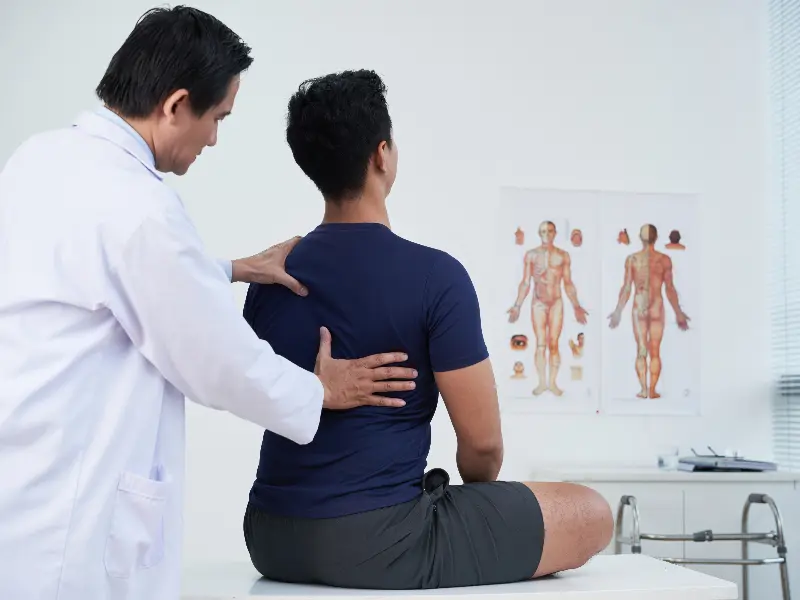
Specific Chiropractic Care in Fuquay-Varina, NC
Going to a chiropractor who specializes in sports performance increases the outcomes that patients can expect. Our office is CCSP (Certified Chiropractic Sports Physician) certified through the American Chiropractic Board of Sports Physicians. Giving us specific insight into how athletes move and perform. Our providers have all been athletes at one point or another and understand what it takes to keep you playing at the level you want.
The primary condition that most athletes, especially golfers, struggle with is subluxation. A subluxation is any change in a joint’s ability to move or function freely and fully as it is intended to. These subluxations can also be called segmental joint restrictions, misalignments, and other synonyms. These subluxations can cut off nerve communication by up to 60%. The biggest change is with proprioception. Proprioception is your body’s ability to know where it is in space. For example, if you close your eyes, can you still touch your nose? If so, how? Because each muscle, tendon, ligament, and joint communicates with your brain to give you feedback about where it is in space. Where there is a subluxation that may diminish this flow back and forth from the brain. Specifically in golf, that may leave you feeling disconnected from your hands and from the angle of your wrist at the top of your backswing. That small change has a huge impact on how well you strike the ball. If this is left unchecked, it will progress, starting to impact the segments above and below that position, leading to bigger issues. It will also lead you to create new patterns or compensations to “fix” the issue, instead of properly addressing it with a chiropractor.
Golfers who would like to reduce pain, increase range of motion, or improve proprioception and feedback between their brain and body are great candidates for chiropractic care.
Deep Tissue Laser
Deep Tissue Laser uses infrared light to penetrate 2-3 inches into the body, accelerating healing. This light works on a cellular level and increases mitochondrial production, or the powerhouse of the cell. This creates more ATP (Adenosine TriPhosphate), which is the measure of energy within our cells. It also increases oxygenation and circulation to the targeted tissues. This laser takes the body’s natural healing process and supercharges it, especially in areas with naturally poor healing properties and blood flow. Areas like discs, ligaments, and nerves respond well to laser therapy.
Deep Tissue Laser feels warm from the inside out. Although most improvement is noted with 3-4 treatments, some patients start feeling better on day 1. Depending on the treatment, it can take as little as 3-4 minutes, but some treatments are longer at 10-12 minutes.
We use this modality frequently with golfers who are struggling with disc injuries or ligament strains. These are common among golfers, and using a laser drastically decreases return-to-play time, getting you back on the course sooner.
Another condition that responds well to Deep Tissue Laser is golfer’s elbow. Golfer’s elbow, also known as medial epicondylitis, is inflammation of the tendon and/or the bone at the elbow. This pain can make something as simple as gripping the golf club painful. As all golfers know, the only thing connecting us to the golf club is our hands. So if our grip is off, our entire swing is ruined. This can take months to treat, but utilizing Deep Tissue Laser and a proper treatment plan can get you playing again in no time.
Shockwave Therapy
Shockwave therapy uses both pressure and sound to create a pulsing pressure that penetrates through soft tissue. These shockwaves are used to break up scar tissue and inflammation, thereby promoting blood flow and healing in the muscles, tendons, and ligaments in the area.
Shockwave feels like a mixture between a massage gun and a TENS unit. When using this modality, patients often notice immediate results, such as decreased pain and increased range of motion. Treatments are very quick, and usually complete within 5 minutes, but allow the body to work through the healing process for the next 3-5 days. Big changes from just a few minutes of treatment!
This works fantastically for those experiencing tension or tightness that just won’t let go. It will blast right through muscle spasms and help fix the muscle tension limiting your golf swing. If it’s spasms in your low back before or after a round of golf, or even the dreaded golfer’s elbow, shockwave is a game-changer in treatment plans.
Check Out Our Location Near You
609 Attain St #141, Fuquay-Varina, NC 27526
Frequently Asked Questions
Should golfers go to the chiropractor?
Over 75% of PGA golfers go to the chiropractor. And most recreational players don’t train at the same level as PGA players. Yes, chiropractic is one of the best ways to improve your golf game.
Can chiropractors fix Golfer’s Elbow?
Yes. Chiropractors specialize in musculoskeletal injuries, including golfer’s elbow, which we commonly treat.
Does Tiger Woods use chiropractic?
Tiger uses chiropractic. Scottie Scheffler uses chiropractic. Rory McIlroy uses chiropractic. Chiropractic has become a major part of almost every PGA player’s routine.
Do PGA Tour players use chiropractors?
Yes. Over 75% of PGA Tour players report chiropractic use.
Why won’t my golfer’s elbow go away?
Golfer’s elbow can be a complex injury, and rarely goes away on its own. The pain can come from the tendon or from the bones at the insertion point. Procrastinating care often prolongs treatment plans. If you are currently treating it and not seeing improvement, the treatment is likely targeting the wrong part of the injury or the tissue. Seek guidance from a specialist who can perform a thorough examination to get to the root cause.
Can you play golf after a chiropractic adjustment?
Yes. A round of golf following a chiropractic adjustment may lead to one of your best rounds of golf.
How often should an athlete see a chiropractor?
The frequency of treatment varies widely among athletes. Frequency will depend on factors such as the type of injury, whether the issue is acute or chronic, how often the athlete competes or plays, and the athlete’s specific goals. Each patient in our office is prescribed an individualized treatment plan based on this information and more.
What are the most common golf-related injuries?
Low back pain and golfer’s elbow are the top two conditions that plague golfers. Both can be successfully treated with chiropractic care.
What are the best pain relief exercises for golfers?
Spinal stabilization, spinal mobility, and hip mobility are the top things most golfers can benefit from. There are many ways to achieve these, but two of my favorites are bird dogs and hip 90-90s. These two exercises are a great foundation for any golfer’s warm-up and training routine.
$99 New Patient Special
Includes consultation, exam, doctors report of findings, PosturePro analysis, and first adjustment.